第 14 名解决方案
首先,我要真诚地感谢 ISIC 2024 竞赛的组织者。我还要感谢 @daikon99 和 @yuyagi 与我组队!代表我的团队,我很兴奋分享我们的解决方案。
推理管道概述
我们基于这个优秀的 Notebook 进行了改进 (ISIC 2024 Borrowed .179LB Tabular/OOF ImageNet)。为了构建一个对抗方差具有鲁棒性的模型,我们通过增加用于特征提取的 CNN 模型的多样性,最大化了集成的数量。对于最终提交,我们选择了基于信任 LB 的方案和基于信任 CV 的方案。结果,信任 LB 的提交为我们赢得了一枚金牌!
解决方案
验证策略
我们参考了之前的竞赛开发了我们的验证策略。(三重分层无泄漏 KFold 交叉验证)
为了减少拥有大量负样本患者的影响,我们在 Fold 分割中使用了以下方法:
- 对于拥有超过 100 个负样本的患者,我们将每个患者的负样本数量限制为 100 个。
- 应用此限制后,我们以一种确保正样本数量在 Fold 之间平衡的方式划分每个患者 ID 的样本。
- 最后,对于负样本数量受限的患者 ID,我们将所有负样本分配到与相应患者 ID 相同的 Fold 中。
在我们的实验中,使用这种分割训练的 CNN 和 Stacking GBDT 模型与其他分割(基于患者 ID 的分组 K-Fold 或分层分组 K-Fold)相比,与 CV 和私有 LB 具有更高的相关性。
它们在私有 LB 上的表现也优于使用其他分割训练的模型。
neg_counts = 100

target_counts = train_df.groupby('patient_id')['target'].value_counts().unstack(fill_value=0).reset_index()

target_counts.columns = ['patient_id', 'target_0_count', 'target_1_count']
target_counts['total_images'] = target_counts['target_0_count'] + target_counts['target_1_count']
sorted_target_counts = target_counts.sort_values(by='total_images', ascending=False).reset_index(drop=True)

for patient_id in sorted_target_counts['patient_id']:
    target_0_max = sorted_target_counts.loc[sorted_target_counts['patient_id'] == patient_id, 'target_0_count'].values[0]
    if target_0_max >= neg_counts:
        patient_data = train_df[(train_df['patient_id'] == patient_id) & (train_df['target'] == 0)]
        if len(patient_data) > neg_counts:
            patient_data_sample = patient_data.sample(n=neg_counts, random_state=42)
            train_df = train_df[~((train_df['patient_id'] == patient_id) & (train_df['target'] == 0))]
            train_df = pd.concat([train_df, patient_data_sample])
推理管道
结果:CV→0.1793, 公共 LB→0.186 (第 2 名), 私有 LB→0.171
最终管道是三个 Stacking GBDT 模型、无 CNN 预测的 GBDT 模型和单个 CNN 模型的加权平均,如下所示。
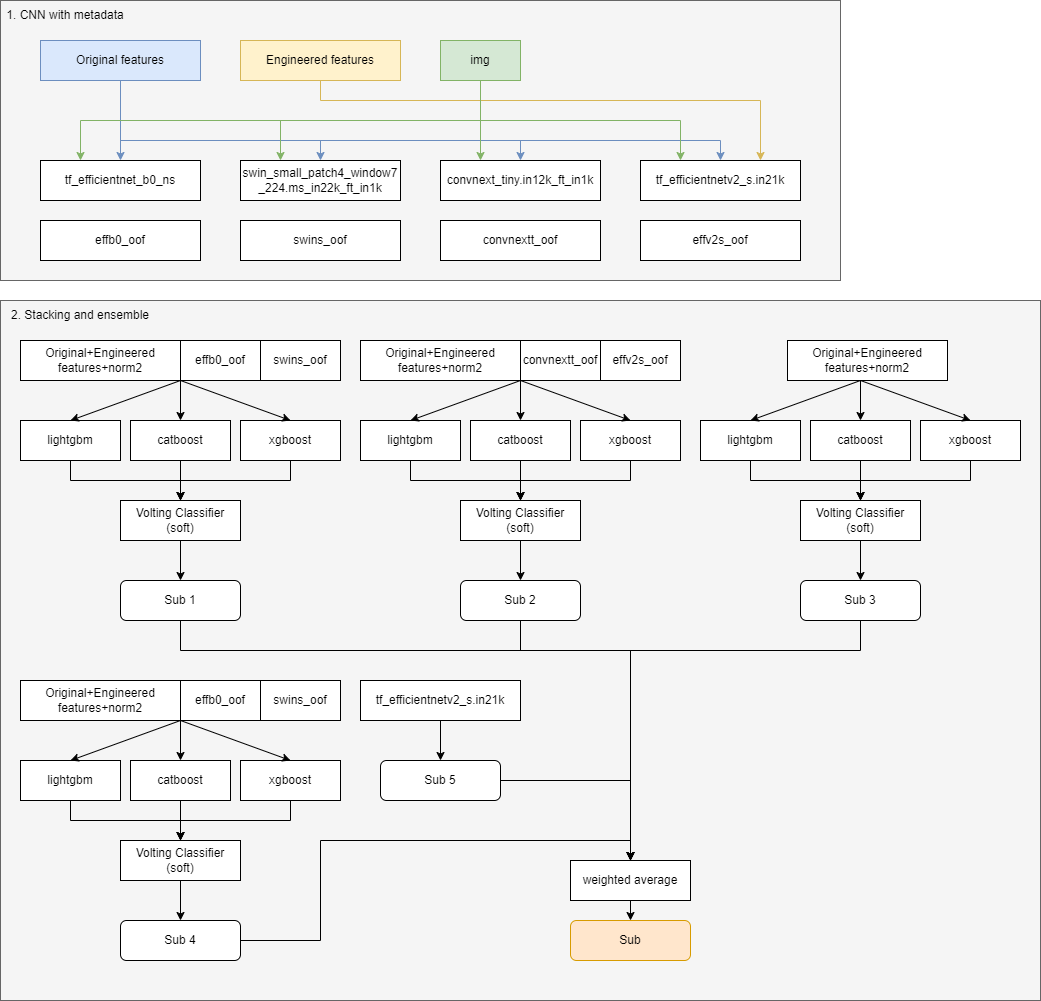
阶段 1. 带元数据的 CNN
输入特征
- 原始特征 (ISIC2024 train_metadata.csv)
- 工程特征 (ISIC 2024 Borrowed .179LB Tabular/OOF ImageNet)
CNN 模型架构
CNN 模型是基于之前竞赛的第 1 名解决方案 (1st place solution) 构建的。
我们修改了这个优秀 Notebook 中的模型以适用于 EfficientNetV2 模型。
# tf_efficientnet_b0_ns, swin_small_patch4_window7_224.ms_in21k_ft_in1k, convnext_tiny.in22k_ft_in1k
class ISICModel(nn.Module):
    def __init__(self, model_name, n_meta_features,model_output_size, num_classes=1, pretrained=False,):
        super(ISICModel, self).__init__()
        self.model = timm.create_model(model_name, pretrained=pretrained)

        self.model.classifier = nn.Identity()

        self.meta_fc1 = nn.Linear(n_meta_features, 64)
        self.meta_fc2 = nn.Linear(64, 64)

        self.fc1 = nn.Linear(1128, 512) # swins → 1128
        self.fc2 = nn.Linear(512, 256)
        self.fc3 = nn.Linear(256, num_classes)

        n_meta_dim = [512, 128]
        self.meta = nn.Sequential(
                nn.Linear(n_meta_features, n_meta_dim[0]),
                nn.BatchNorm1d(n_meta_dim[0]),
                nn.Dropout(p=0.3),
                nn.Linear(n_meta_dim[0], n_meta_dim[1]),
                nn.BatchNorm1d(n_meta_dim[1]),
        )

    def forward(self, x):
        images, meta = x
        x1 = self.model(images)
        x2 = self.meta(meta)
        x = torch.cat((x1, x2), dim=1)
        x = torch.relu(self.fc1(x))
        x = torch.relu(self.fc2(x))
        x = self.fc3(x)
        return x

# tf_efficientnetv2_s_in1k
class ISICModel(nn.Module):
    def __init__(self, model_name, num_classes=1, pretrained=True, config=None, meta_features=200):
        super(ISICModel, self).__init__()
        self.is_feature_only = True
        try:
            self.model = timm.create_model(
                model_name, in_chans=3, pretrained=pretrained, features_only=True
            )
            in_features = self.model.feature_info[-1]['num_chs']
        except Exception as e:
            print(e)
            self.model = timm.create_model(
                model_name, in_chans=3, num_classes=1, pretrained=pretrained)
            in_features = self.model.head.in_features
            self.model.head = nn.Identity()
            self.is_feature_only = False

        self.pooling = GeM()
        self.linear = nn.Linear(in_features + meta_features//2, num_classes)
        self.criterion = nn.BCEWithLogitsLoss()
        self.config = config
        self.training_step_outputs = []
        self.validation_step_outputs = []

        self.meta_bn = nn.BatchNorm1d(meta_features)
        self.meta_linear = nn.Linear(
            meta_features, meta_features//2)

    def forward(self, images, meta_data):
        if self.is_feature_only:
            features = self.model(images)[-1]
            if features.shape[1] == features.shape[2]:
                features = features.permute(0, 3, 1, 2)
        else:
            features = self.model.forward_features(images).unsqueeze(1)
            features = features.permute(0, 3, 1, 2)
        pooled_features = self.pooling(features).flatten(1)

        meta_data = self.meta_bn(meta_data)
        meta_data = self.meta_linear(meta_data)

        combined_features = torch.cat([pooled_features, meta_data], dim=1)

        output = self.linear(combined_features)
        return output
数据增强
对于数据增强,我们基于之前竞赛的第 1 名解决方案 (1st place solution)。
# tf_efficientnet_b0_ns, swin_small_patch4_window7_224.ms_in21k_ft_in1k, convnext_tiny.in22k_ft_in1k
A.Resize(CONFIG['img_size'], CONFIG['img_size']),
A.RandomRotate90(p=0.5),
A.Flip(p=0.5),
A.RandomBrightnessContrast(
    brightness_limit=0.2, contrast_limit=0.2, p=0.5),
A.OneOf([
    A.OpticalDistortion(distort_limit=1.0),
    A.GridDistortion(num_steps=5, distort_limit=1.),
    A.ElasticTransform(alpha=3),
], p=0.7),
A.Downscale(p=0.25),
A.HueSaturationValue(hue_shift_limit=10, sat_shift_limit=20, val_shift_limit=10, p=0.5),
A.ShiftScaleRotate(shift_limit=0.1,
                    scale_limit=0.15,
                    rotate_limit=60,
                    p=0.5),
A.CoarseDropout(max_height=int(CONFIG['img_size'] * 0.375),
                max_width=int(CONFIG['img_size'] * 0.375),
                max_holes=1, p=0.7),
A.Normalize()

# tf_efficientnetv2_s_in1k
A.Resize(CONFIG['img_size'], CONFIG['img_size']),
A.RandomRotate90(p=0.5),
A.Flip(p=0.5),
A.OneOf([
    A.OpticalDistortion(distort_limit=1.0),
    A.GridDistortion(num_steps=5, distort_limit=1.),
    A.ElasticTransform(alpha=3),
], p=0.5),
A.HueSaturationValue(hue_shift_limit=1, sat_shift_limit=1, val_shift_limit=1, p=0.5),
A.RandomBrightnessContrast(
    brightness_limit=0.2, contrast_limit=0.2, p=0.5),
A.Normalize()
CNN 模型的 CV 和公共 LB 结果
| 骨干网络 | 使用原始特征 | 使用工程特征 | 欠采样 | 学习率 | 图像大小 | CV | 公共 LB |
|---|---|---|---|---|---|---|---|
| tf_efficientnet_b0_ns | ◯ | × | 每个患者最多使用 100 个负样本 | 3e-4 | 128 | 0.151 | 0.161 |
| swin_small_patch4_window7_224.ms_in21k_ft_in1k | ◯ | × | 每个患者最多使用 100 个负样本 | 1e-5 | 224 | 0.153 | 0.162 |
| convnext_tiny.in22k_ft_in1k | ◯ | × | 每个患者最多使用 100 个负样本 | 1e-4 | 288 | 0.155 | 0.163 |
| tf_efficientnetv2_s_in1k | ◯ | ◯ | 从所有负样本中随机欠采样 | 1e-4 | 224 | 0.165 | 0.170 |
阶段 2. Stacking GBDT 和集成
输入特征
- 原始特征 (ISIC2024 train_metadata.csv)
- 工程特征 (ISIC 2024 Borrowed .179LB Tabular/OOF ImageNet)
- Norm2 (聚合特征)
- CNN 预测
特征选择
使用 Notebook 中的思路,计算每个 Stacking 模型的特征重要性,并移除重要性为 0.0 的不必要特征。结果,CV 和 LB 分数均有所提高。
Norm2: 聚合特征 (patient_id + tbp_lv_location_simple)
除了基础 Notebook 特征外,使用 patient_id 和 tbp_lv_location_simple 添加以下聚合特征。
pl.read_csv(path)
.with_columns(
    (pl.col('patient_id') + '_' + pl.col('tbp_lv_location_simple')).alias('patient_id_location')
)
.with_columns(
    ((pl.col(col) - pl.col(col).mean().over('patient_id_location')) / (pl.col(col).std().over('patient_id_location') + err)).alias(f'{col}_patient_location_norm') for col in (num_cols + new_num_cols)
)
集成中使用的模型的 CV 结果
对于 stacking 模型,有人提议要么增加用作特征的模型数量,要么增加 GBDT 的数量。实验结果表明,将用作特征的模型数量限制为最多 2 个,同时增加 GBDT 的数量,在 CV 和 LB 上都产生了更好的结果。
此外,tf_efficientnetv2_s_in1k 在 CV 和公共 LB 中得分最高,因此我们将其作为集成模型采用。
| 模型名称 | oof_1 | oof_2 | 使用 norm2 | 集成权重 | CV |
|---|---|---|---|---|---|
| GBDT_1(lgb+cb+xgb) | tf_efficientnet_b0_ns | swin_small_patch4_window7_224.ms_in21k_ft_in1k | × | 1.882e-01 | 0.178 |
| GBDT_2(lgb+cb+xgb) | tf_efficientnet_b0_ns | swin_small_patch4_window7_224.ms_in21k_ft_in1k | ◯ | 4.963e-01 | 0.179 |
| GBDT_3(lgb+cb+xgb) | convnext_tiny.in22k_ft_in1k | tf_efficientnetv2_s_in1k | ◯ | 1.534e-01 | 0.180 |
| GBDT_4(lgb+cb+xgb) | × | × | ◯ | 5.075e-02 | 0.171 |
| tf_efficientnetv2_s_in1k only | × | × | × | 2.702e-04 | 0.165 |
集成方法
我们的集成方法使用加权平均,其中权重计算为最小化损失。
from scipy.optimize import minimize

def ensemble_loss(weights):
    weights = np.array(weights)
    weights = weights / np.sum(weights)

    ensemble_preds = weights[0] * oof_1['oof_pred'] + weights[1] * oof_2['oof_pred'] + weights[2] * oof_3['oof_pred'] + weights[3] * oof_4['oof_pred'] + weights[4] * oof_5['oof_pred']
    # calculate loss
    return 1 - comp_score(df_train["target"], ensemble_preds)

result = minimize(
    ensemble_loss,
    [1/5, 1/5, 1/5, 1/5, 1/5],
    method='Nelder-Mead',
    )
print(1-result.fun)
print(result)
无效的方法
- 将仅存在于训练数据中的特征作为 CNN 的预测目标添加。
- 如果活检则使用软标签
- age_approx 的后处理
- TTA
- 验证中未知医院的 Fold 分割
- 向单个 GBDT 添加 3 个或更多 oof 特征
- 添加头发增强
- 改为 Focal loss
- 使用过去竞赛数据进行预训练
- 排名集成