第二名方案
首先,感谢 Kaggle 和组织者。我从这次经历中学到了很多。
1. 模型
在早期,将 bsx4xHxW 输入馈送到 2D‑CNN 产生的结果比单图像方法更差。我开始思考为什么?
由于标签(LPD、GPD 等)对位置敏感,我们应该注意通道维度。2D‑CNN 不擅长捕捉通道内的位置信息,因为通道方向没有填充。这就是为什么我们需要将频谱拼接成一张图像,而不是使用 bsx16xHxW 的图像(双香蕉 montage)。因此,我决定对频谱使用 3D‑CNN,对原始 EEG 信号使用 2D‑CNN 模型。
总方案如下:
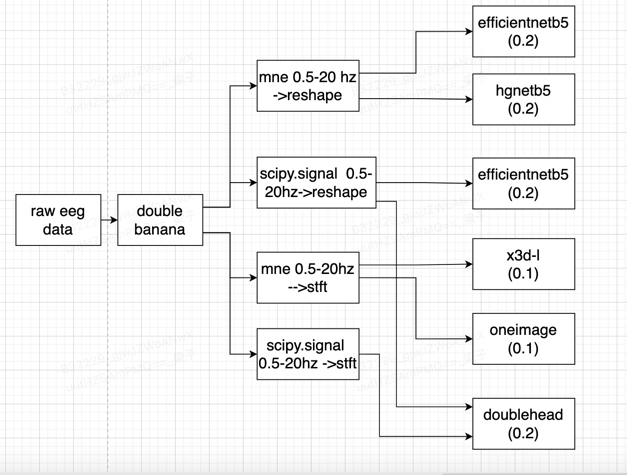
- mne 0.5‑20Hz 表示使用 MNE 工具进行滤波。
- scipy.signal 表示使用 scipy.signal 进行滤波。
- 关于 reshape 算子和 STFT 参数,请参阅下面的代码。
- 括号中的数字表示集成时的最终权重。
1.1 x3d‑l(频谱模型)
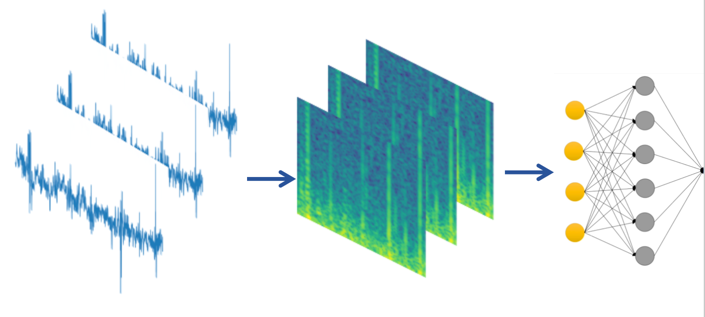
在双香蕉 montage、±1024 裁剪和 0.5‑20 Hz 滤波后,使用 STFT 提取频谱,然后输入到 3D‑CNN(x3d‑l)。
输入数据是一个 16 通道的频谱图像。
X3d‑l 交叉验证 0.21+,公开排行榜 0.25,私有排行榜 0.29。
STFT 代码如下,作为一个 nn.Module 使用:
class Transform50s(nn.Module):
    def __init__(self, ):
        super().__init__()
        self.wave_transform = torchaudio.transforms.Spectrogram(n_fft=512, win_length=128, hop_length=50, power=1)

    def forward(self, x):
        image = self.wave_transform(x)
        image = torch.clip(image, min=0, max=10000) / 1000
        n, c, h, w = image.size()
        image = image[:, :, :int(20 / 100 * h + 10), :]
        return image

class Transform10s(nn.Module):
    def __init__(self, ):
        super().__init__()
        self.wave_transform = torchaudio.transforms.Spectrogram(n_fft=512, win_length=128, hop_length=10, power=1)

    def forward(self, x):
        image = self.wave_transform(x)
        image = torch.clip(image, min=0, max=10000) / 1000
        n, c, h, w = image.size()
        image = image[:, :, :int(20 / 100 * h + 10), :]
        return image

class Model(nn.Module):
    def __init__(self):
        super().__init__()

        model_name = "x3d_l"
        self.net = torch.hub.load('facebookresearch/pytorchvideo',
                                  model_name, pretrained=True)

        self.net.blocks[5].pool.pool = nn.AdaptiveAvgPool3d(1)
        # self.net.blocks[5]=nn.Identity()
        # self.net.avgpool = nn.Identity()
        self.net.blocks[5].dropout = nn.Identity()
        self.net.blocks[5].proj = nn.Identity()
        self.net.blocks[5].activation = nn.Identity()
        self.net.blocks[5].output_pool = nn.Identity()

    def forward(self, x):
        x = self.net(x)
        return x

class Net(nn.Module):
    def __init__(self, num_classes=1):
        super().__init__()

        self.preprocess50s = Transform50s()
        self.preprocess10s = Transform10s()

        self.model = Model()

        self.pool = nn.AdaptiveAvgPool3d(1)
        self.fc = nn.Linear(2048, 6, bias=True)
        self.drop = nn.Dropout(0.5)

    def forward(self, eeg):
        # do preprocess
        bs = eeg.size(0)
        eeg_50s = eeg
        eeg_10s = eeg[:, :, 4000:6000]
        x_50 = self.preprocess50s(eeg_50s)
        x_10 = self.preprocess10s(eeg_10s)
        x = torch.cat([x_10, x_50], dim=1)
        x = torch.unsqueeze(x, dim=1)
        x = torch.cat([x, x, x], dim=1)
        x = self.model(x)
        # x = self.pool(x)
        x = x.view(bs, -1)
        x = self.drop(x)
        x = self.fc(x)
        return x
1.2 单图像(One‑Image)
它是一个 2D 视觉模型 efficientnetb5,公开排行榜 0.26 2490,私有排行榜 0.304877。
对于 2D 模型,我像许多人一样将 16 通道频谱图像拼接起来。
        image = torch.reshape(image, shape=[n, 2, -1, w])
        x1 = image[:, 0:1, ...]
        x2 = image[:, 1:2, ...]
        image = torch.cat([x1, x2], dim=-1)
        image = torch.cat([image, image, image], dim=1)
我检查了提交分数,将这两个频谱模型组合后,得到私有排行榜 0.28。
1.3 EEG 模型
将 EEG(bs×16×10000)视为图像。于是扩展 dim=1(bs×1×16×10000),但时间维度太大,然后我做了一个 reshape。
模型定义如下:
class Net(nn.Module):
    def __init__(self,):
        super(Net, self).__init__()
        self.model = timm.create_model('efficientnet_b5', pretrained=True, in_chans=3)
        self.pool = nn.AdaptiveAvgPool2d(1)
        self.fc = nn.Linear(2048, out_features=6, bias=True)
        self.dropout = nn.Dropout(p=0.5)

    def extract_features(self, x):
        feature1 = self.model.forward_features(x)
        return feature1

    def forward(self, x):
        bs = x.size(0)
        reshaped_tensor = x.view(bs, 16, 1000, 10)
        reshaped_and_permuted_tensor = reshaped_tensor.permute(0, 1, 3, 2)
        reshaped_and_permuted_tensor = reshaped_and_permuted_tensor.reshape(bs, 16 * 10, 1000)
        x = torch.unsqueeze(reshaped_and_permuted_tensor, dim=1)

        x = torch.cat([x, x, x], dim=1)
        bs = x.size(0)

        x = self.extract_features(x)
        x = self.pool(x)
        x = x.view(bs, -1)
        x = self.dropout(x)
        x = self.fc(x)
        return x
然后,EEG 被 reshape 为 bs×3×160×1000。使用 efficientnetb5,公开排行榜 0.230978,私有排行榜 0.282873。
有 3 个模型,但略有不同:mne 滤波 efficientnetb5、scipy.signal 滤波 efficientnetb5 以及 mne 滤波 hgnetb5。相应的分数也略有不同。
1.4 双头模型(EEG+频谱)
我使用 x3d‑l 提取频谱特征(仅使用 Transform50s),使用 efficientnetb5 提取原始 EEG 特征,如方案图所示。连接最后的特征。公开排行榜 0.24,私有排行榜 0.29?不确定。
2. 预处理
- 2.1 双香蕉 montage,EEG 为 16×10000
- 2.2 使用 0.5‑20 Hz 滤波
- 2.3 裁剪至 ±1024
3. 训练
- 3.1 第一阶段,15 个 epoch,损失权重为 voters_num/20,AdamW 学习率 0.001,余弦学习率调度。
- 3.2 第二阶段,5 个 epoch,损失权重为 1,voters_num≥6,AdamW 学习率 0.0001,余弦调度。
- 3.3 使用 eeg_label_offset_seconds。我为每个 eegid 随机选择一个偏移,并在每个训练迭代中根据 eegid 对目标取平均。
- 3.4 数据增强:镜像 EEG,左右脑数据翻转。
- 3.5 10 折,然后从验证集移动 1000 个样本到训练集,保留 709 个样本在验证集。并使用 vote_num≥6 进行验证。
4. 集成
通过组合这些模型,我认为可以达到当前的分数。然而我的分数是 6 模型集成,提升并不明显(私有排行榜 0.28 → 0.27)。
最终集成包括:
- 2 个频谱模型(x3d、efficientnetb5),均使用 mne 滤波
- 3 个原始 EEG 模型(efficientnetb5 使用 mne 滤波、efficientnetb5 使用 butter 滤波、1 个 hgnetb5 使用 mne 滤波)
- 1 个 EEG‑频谱混合模型,使用 butter 滤波
权重为 [0.1, 0.1, 0.2, 0.2, 0.2, 0.2]。
注:with‑mne.filter 表示使用 mne 库进行滤波,butter 滤波表示使用 scipy.signal,只是为了增加多样性。
一些思考
我认为原始 EEG 在这项任务中更为重要。将原始 EEG 数据馈送到 2D 视觉模型有点像人类观察 EEG 信号的方式。观察时间和通道维度!