第45名解决方案、学习心得、尝试过程与未尽之事 | 0.919/0.917 提交过晚 :D
首先感谢Kaggle举办这场比赛,为我们打开了尝试大语言模型(LLM)并解决那些被认为只有现代LLM才能解决的问题的大门。感谢社区慷慨地分享想法和代码,没有这些,我们大多数人可能无法取得如此大的进展。还要感谢我们的团队成员@urvishp80 @ayaanjang @tonymarkchris,他们在过程中加入并提供了帮助。我们很幸运及时确定了CV(交叉验证),但未能及时提交在私有榜上获得0.917/0.919的LB分数。不过我们及时确定了前者(0.917),这仍然很不错 :)
数据集
训练数据集
以下是对我们效果最好的数据集:
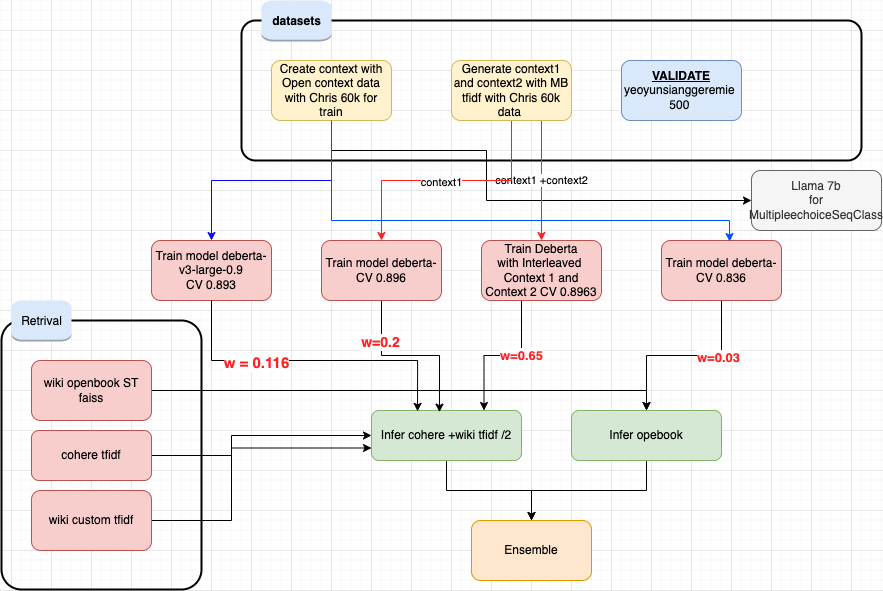
- Chris的60k带上下文数据集
- 使用@mbanaei的TF-IDF方法生成的context1和context2,包含270k数据和Cohere数据
验证
感谢@yeoyunsianggeremie提供的这个数据集https://www.kaggle.com/datasets/yeoyunsianggeremie/validation-500。这帮助我们获得了CV和LB之间的关联性。
检索/推理
- Openbook minilm,虽然我们也尝试了mpnet-base-v2且效果不错,但最终提交中未包含[使用openbk时为0.834 LB分数]。
- 在维基百科数据上使用的MB tfidf技术,数据来自https://www.kaggle.com/code/nbroad/create-science-wikipedia-dataset - 效果良好
- MB在Cohere上的tfidf技术 - 效果良好
- 我们在推理检索中未使用270k的MB数据集
- 我们发现MB notebook中的排序顺序是基于分数的逆序/升序,我们对此进行了简单修正,这很有帮助
context1 = f"{retrieved_articles[index][-1][2]}\\n{retrieved_articles[index][-2][2]}\\n{retrieved_articles[index][-3][2]}\\n{retrieved_articles[index][-4][2]}"训练
- CV 0.893(在500数据集上)在60k带上下文数据上训练的Deberta
- CV 0.8963(在500数据集上)在context1和context2 tfidf上下文数据上训练的Deberta,使用interleaved(交错)方式与hugging face datasets结合,示例见https://www.kaggle.com/code/gauravbrills/customdeberta-w-context-seq-mix/notebook - 交错训练似乎极大地帮助了模型泛化
- CV 0.896(在500数据集上)仅在60k上通过tfidf生成的context 1上训练的Deberta
- CV 0.836(在500数据集上)在60k数据集上训练、冻结15层的Deberta
- CV 0.92 Llama,但在100数据集上训练,在LB上表现不佳,使用PEFT进行多选序列分类
我们最佳模型(0.8963 CV)在交错数据集上的训练图,训练时CV为0.8917:
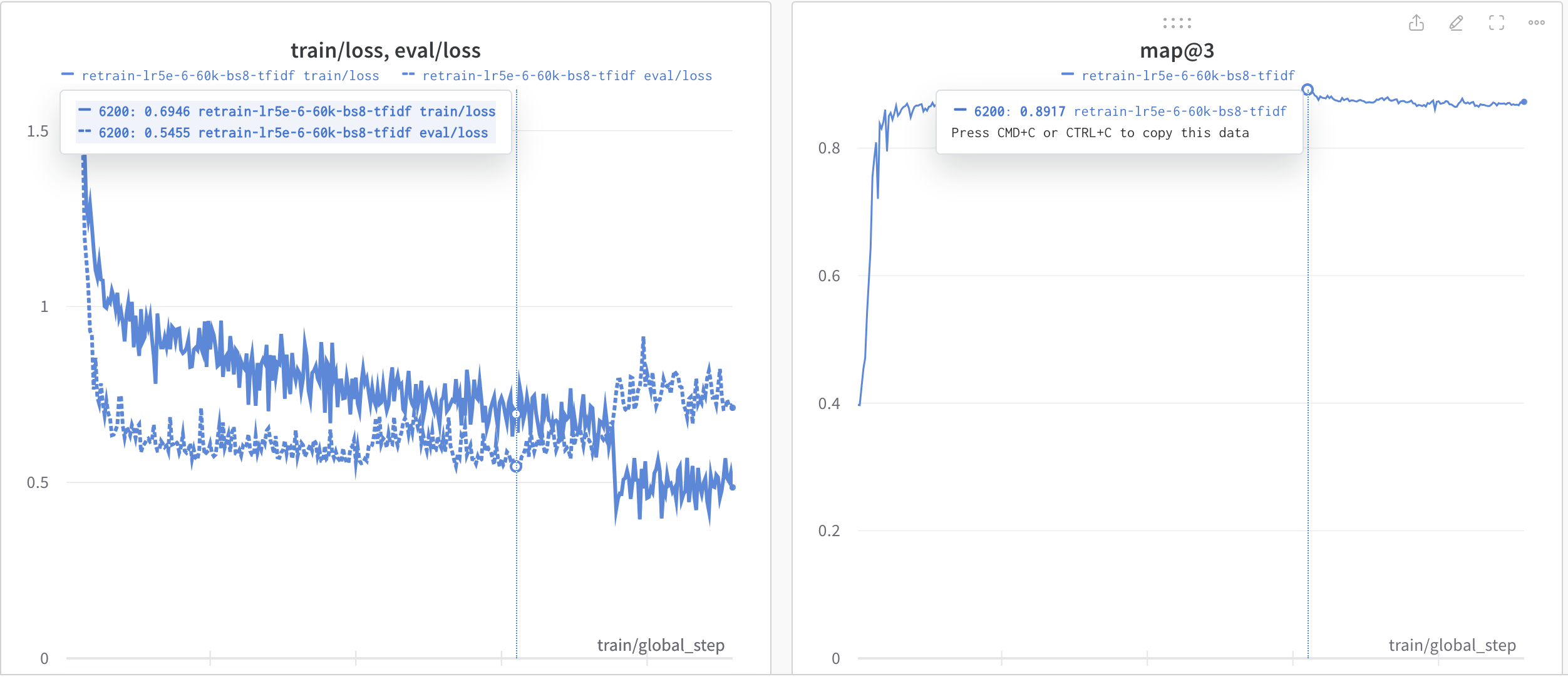
参数设置:
warmup_ratio=0.02,
    learning_rate=5e-6,
    per_device_train_batch_size=2,
    per_device_eval_batch_size=2,
    num_train_epochs=1,
FREEZE_LAYERS = 15
最终集成与推理
在我们获得500数据集之前,我们一直在集成方面挣扎。我们只是将带上下文和不带上下文的模型以及有时使用Llama进行混合,但始终对提交结果缺乏信心。一旦我们获得了500数据集,我们就挑选出排名前3的模型,并使用`average`(平均)和`optuna`加权集成。https://www.kaggle.com/code/gauravbrills/t2-0-901-openbook-tfidf?scriptVersionId=146318816
我们很幸运地成功提交了一些结果,但错过了最后几个可能获得0.917/0.919 LB分数的提交,因为没有时间了。
| CV | 私有榜LB | 公开榜LB | 描述 |
|---|---|---|---|
| 0.9036 | 0.909 | 0.903 | 截止时间前加权略优 |
| 0.9017 | 0.909 | 0.905 | 截止时间前已选 |
| 0.91 | 0.919297 | 0.917 | 提交过晚 😃 |
| 0.908 | 0.917 | 0.912 | 提交过晚 😃 |
尝试过但未奏效或可能奏效的方法
- 重排序器:我们尝试了多个重排序器,包括ST marco系列,但它们对公开榜LB没有帮助,虽然在私有榜上似乎效果不错。我们还研究了colbert和https://huggingface.co/ibm/re2g-reranker-nq,其他团队也尝试过这些方法,但我们不知为何失去了信心。
- 在不同上下文的openbook tfidf上进行训练,我们也曾尝试生成上下文来检验效果,但未能及时完成。
- 数据集清洗:我们尝试使用mwparserfromhell、LatexNodes2Text和beautiful soup,但只是随便试试,没有耐心从头开始清洗wiki数据。似乎一些顶尖团队在这方面做了更好的探索和实现。
from pylatexenc.latex2text import LatexNodes2Text
from bs4 import BeautifulSoup
import mwparserfromhell
#import wikitextparser as wtp

def context_cleaner(text):
    ## 解析Latex
    l2t = LatexNodes2Text()
    #text = l2t.latex_to_text(text)
    ## 解析wiki媒体
    #text = wtp.parse(text)
    code = mwparserfromhell.parse(text)
    print(code.filter_templates())
    for template in code.filter_templates():
        print(template)
        code.replace(template, l2t.latex_to_text(str(template)))
    text = str(code)
    text = text.replace("==References==", "").replace("==External links==", "")
return text- 使用不同嵌入的FAISS和通过ST的简单余弦相似度,我们发现不同嵌入的FAISS索引得分不如tfidf好,因此放弃了尝试其他嵌入,尽管它快得多。余弦相似度在GPU上计算量较大,因此我们也放弃了使用,尽管我们认为它的检索效果不错。这些都是在minilm上尝试的,我们未能及时完成在BGE或e5上的尝试 :(
- 大语言模型:我们团队的Urvish成功实现了使用Llama进行多选序列分类。但我们的推理耗时约4-5小时,最终无法将其加入集成。此外,我们也未能显著提升Llama的CV分数。
@urvishp80的自定义Llama模型:
class CustomLlamaModel(nn.Module):
    def __init__(self, backbone, num_labels, use_gradient_checkpointing=False):
        super(CustomLlamaModel, self).__init__()
        self.model = backbone
        self.model.config.use_cache = False
        self.config = self.model.config
        self.num_labels = num_labels

        if use_gradient_checkpointing:
                        self.model.gradient_checkpointing_enable()
        self.pooler = MeanPooling()
        self.dense = nn.Linear(self.config.hidden_size, 1024)
        self.dropout = nn.Dropout(0.2)
        self.classifier = nn.Linear(self.config.hidden_size, 1, bias=False)

    def forward(self, input_ids, attention_mask, token_type_ids=None, position_ids=None, head_mask=None,
                inputs_embeds=None, labels=None):
        num_choices = input_ids.shape[1] if input_ids is not None else inputs_embeds.shape[1]
        batch_size = input_ids.shape[0] if input_ids is not None else inputs_embeds.shape[0]

        flat_input_ids = input_ids.view(-1, input_ids.size(-1)) if input_ids is not None else None
        flat_position_ids = position_ids.view(-1, position_ids.size(-1)) if position_ids is not None else None
        flat_token_type_ids = token_type_ids.view(-1, token_type_ids.size(-1)) if token_type_ids is not None else None
        flat_attention_mask = attention_mask.view(-1, attention_mask.size(-1)) if attention_mask is not None else None
        flat_inputs_embeds = (
            inputs_embeds.view(-1, inputs_embeds.size(-2), inputs_embeds.size(-1))
            if inputs_embeds is not None
            else None
        )

        outputs = self.model.model(input_ids=flat_input_ids, attention_mask=flat_attention_mask, output_attentions=False,
            output_hidden_states=True)

        # 从基础模型获取最后的隐藏状态
        # last_hidden_state = outputs[0]
        # # 从基础模型获取最后的隐藏状态
        # last_hidden_state = outputs[0]
        # 从所有层获取隐藏状态
        last_hidden_state = outputs[1][-1]

        x = self.pooler(last_hidden_state, flat_attention_mask)
        x = self.dropout(x)
        logits = self.classifier(x)
        reshaped_logits = logits.view(batch_size, num_choices)

        loss = None
        if labels is not None:
            loss_fct = nn.CrossEntropyLoss()
            loss = loss_fct(reshaped_logits, labels)

        if self.model.config.output_attentions:
            attentions = outputs.attentions
        else:
            attentions = None

        if self.model.config.output_hidden_states:
            hidden_states = outputs.hidden_states
        else:
            hidden_states = None

        return SequenceClassifierOutput(
            loss=loss,
            logits=reshaped_logits,
            hidden_states=hidden_states,
            attentions=attentions,
        )
最终,这对我们所有人来说都是一次很棒的学习经历,我们仍然从这场比赛中学到了很多可以应用于现实世界的知识。随着回忆起更多尝试过的事情,我会更新这篇文章,或者可能会写一篇博客。