感谢Kaggle和UBC举办这场精彩的比赛,也祝贺所有获奖者所付出的努力!同时也要感谢我的队友以及论坛中的每一位朋友提供的帮助!
方法
概述
我们的最终方案基于多实例学习(MIL)进行卵巢癌亚型分类,并使用Sigmoid和阈值法进行异常值检测。在最终提交中,我们没有使用掩码标注和额外的数据集。
1. 预处理
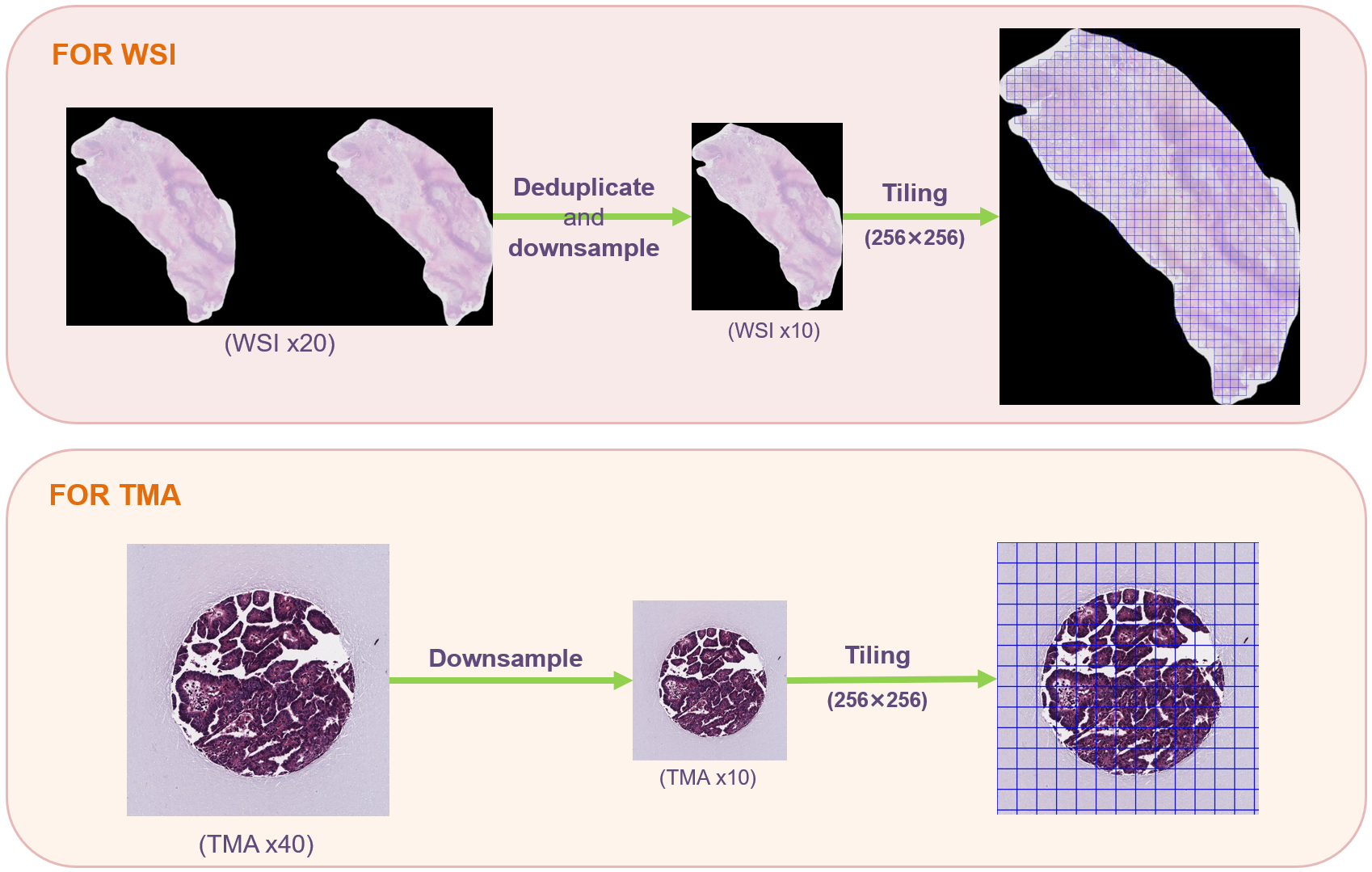
1. 使用 pyvips 来加速PNG图像的读取速度。(感谢 GUNES EVITAN 的 pyvips 笔记本。)
image = pyvips.Image.new_from_file(image_id, access='sequential').numpy()
is_tma = image.shape[0] <= 5000 and image.shape[1] <= 5000
2. 将WSI和TMA分别从20倍和40倍下采样至10倍。(也许20倍的效果会更好,但由于资源限制,我无法提交。)
if is_tma:
    resize = A.Resize(image.shape[0] // 4, image.shape[1] // 4)
else:
    resize = A.Resize(image.shape[0] // 2, image.shape[1] // 2)
image = resize(image=image)['image']
3. 对WSI中相同的组织区域进行去重。(我不确定这是否对结果有贡献,但它节省了大量本地内存。)
def rgb2gray(image: np.ndarray):
    image = image.astype(np.float16)
    image = (image[..., 0] * 299 + image[..., 1] * 587 + image[..., 2] * 114) / 1000
    return image.astype(np.uint8)

if not is_tma:
    resize = A.Resize(image.shape[0] // 16, image.shape[1] // 16)
    thumbnail = resize(image=image)['image'].astype(np.float16)
    mask = rgb2gray(thumbnail) > 0
    x0, y0, x1, y1 = get_biggest_component_box(mask)

    scale_h = image.shape[0] / thumbnail.shape[0]
    scale_w = image.shape[1] / thumbnail.shape[1]

    x0 = max(0, math.floor(x0 * scale_w))
    y0 = max(0, math.floor(y0 * scale_h))
    x1 = min(image.shape[1] - 1, math.ceil(x1 * scale_w))
    y1 = min(image.shape[0] - 1, math.ceil(y1 * scale_h))
    image = image[y0: y1 + 1, x0: x1 + 1]
4. 使用非重叠滑动窗口方法将组织区域切割为256x256的图像块。(对于TMA我使用了重叠窗口,但不确定这是否会影响结果。)
def image2patches(image: np.ndarray, patch_size: int, step: int, ratio: float, transform, is_tma: bool):
    patches = []
    for i in range(0, image.shape[0], step):
        for j in range(0, image.shape[1], step):
            patch = image[i: i + patch_size, j: j + patch_size, :]
            if patch.shape != (patch_size, patch_size, 3):
                patch = np.pad(patch, ((0, patch_size - patch.shape[0]), (0, patch_size - patch.shape[1]), (0, 0)))

            if is_tma:
                patch = transform(image=patch)['image']
                patches.append(patch)
            else:
                patch_gray = rgb2gray(patch)  # (patch_size, patch_size)
                patch_binary = (patch_gray <= 220) & (patch_gray > 0)

                if np.count_nonzero(patch_binary) / patch_binary.size >= ratio:
                    patch = transform(image=patch)['image']
                    patches.append(patch)

    if len(patches) != 0:
        patches = torch.stack(patches, dim=0)
    else:
        patches = torch.zeros(0, dtype=torch.uint8)

    return patches

image2patches(image, 256, [256, 128][is_tma], 0.25, transform, is_tma)
2. 亚型分类
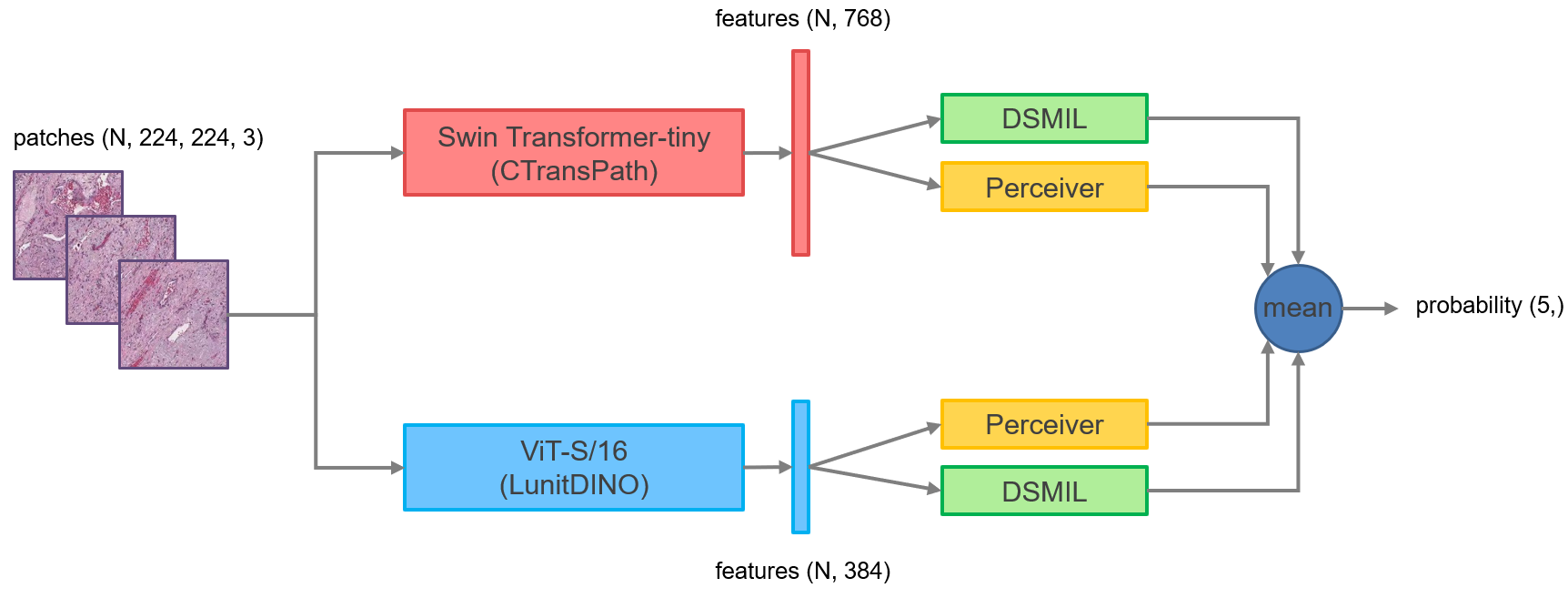
癌症亚型分类方法主要基于多实例学习(MIL)。在尝试了多种骨干网络和MIL方法后,最终选择了 CTransPath 和 LunitDINO 作为骨干网络,DSMIL 和 Perceiver 作为MIL分类器。具体信息请参考:
本地交叉验证结果:
| 实验 | CC | EC | HGSC | LGSC | MC | 平均 |
|---|---|---|---|---|---|---|
| CTransPath + DSMIL | 0.9300 | 0.7657 | 0.8909 | 0.7822 | 0.7911 | 0.8320 |
| CTransPath + Perceiver | 0.9695 | 0.8147 | 0.8818 | 0.8044 | 0.9156 | 0.8772 |
| LunitDINO + DSMIL | 0.9400 | 0.7240 | 0.8864 | 0.8244 | 0.9356 | 0.8621 |
| LunitDINO + Perceiver | 0.9300 | 0.7983 | 0.8591 | 0.8711 | 0.8933 | 0.8704 |
排行榜结果:
| 实验 | 公共榜 | 私有榜 |
|---|---|---|
| CTransPath + LunitDINO + DSMIL | 0.57 | 0.54 |
| CTransPath + LunitDINO + Perceiver | 0.58 | 0.57 |
| CTransPath + LunitDINO + DSMIL + Perceiver | 0.6 | 0.58 |
我几乎没有调整MIL的超参数,因为发现交叉验证分数较高的模型在公共榜上的表现反而较低。
- 对于
DSMIL,我们使用nn.CrossEntropyLoss作为损失函数。 - 对于
Perceiver,我们使用nn.BCEWithLogitsLoss作为损失函数,并采用mixup、label smoothing来缓解过拟合。
3. 异常值检测
我们尝试了许多方法,其中两种方法在私有榜上可以达到0.6的分数。(如果不使用异常值检测,私有榜分数为0.58。)
1. BCE + 阈值法
分数:公共榜 0.6,私有榜 0.6。
这个方法非常简单。使用 nn.BCEWithLogitsLoss 作为损失函数训练模型,然后对最大预测概率进行判断,如果小于0.4,则视为异常值。
logits = self.model(x)
probs = F.sigmoid(logits)  # (C,)
pred = probs.argmax(dim=0).item()
if max(probs) < PROB_THRESH:  # 根据验证集选择阈值
    pred = 5  # 'Other' 类别
2. 概率熵
分数:公共榜 0.54,私有榜 0.6。
这个方法也很简单。与设置概率阈值相比,该方法通过计算概率的熵来检测异常值。
logits = self.model(x)
probs = F.sigmoid(logits)  # (C,)
pred = probs.argmax(dim=0).item()
entropy = (probs * torch.log2(probs)).mean(dim=0)
if entropy > ENTROPY_THRESH:   # 根据验证集选择阈值
    pred = 5  # 'Other' 类别
总结
未成功的方法
- 额外数据集:ATEC、PTRC-HGSOC、CPTAC-OV、TCGA-OV、Bevacizumab。
- 通过注意力或掩码选择癌变区域,并端到端地微调骨干网络和MIL。
- 仅选择癌变区域的图像块用于MIL。
- 基于图像块预测概率熵检测异常值。(MIA2023)
- 基于KNN分类器检测异常值。(Arxiv2023)
补充材料
所有 PyTorch 代码(包括提交笔记本)均基于 一个简单的 PyTorch 深度学习框架 开发。
该框架仅有几百行代码,非常适合初学者学习。